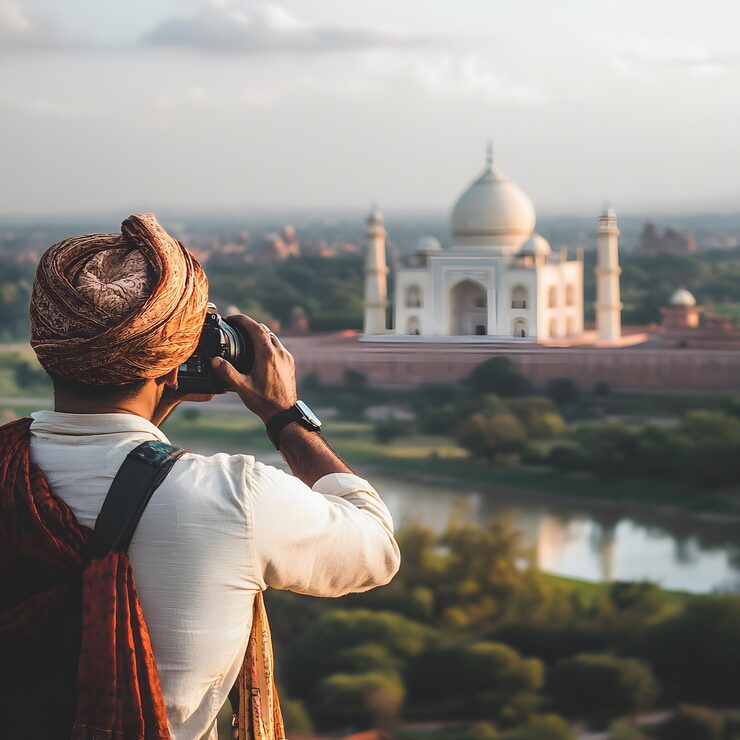
Every traveller approaches the Taj Mahal with a mixture of excitement and mild scepticism. You’ve seen it in thousands of photographs. You know it’s coming. Can it really live up to the expectation?
The honest answer – and this is the experience of the overwhelming majority of visitors – is yes. Not just yes, but emphatically yes. The Taj Mahal is one of the very few monuments in the world that genuinely exceeds expectations in person.
But the experience is not without its challenges, and knowing what to expect before you arrive will help you get the most from it.
The First Sight: What It Actually Feels Like
The Taj Mahal is designed to reveal itself dramatically. You enter through the outer gate, then approach the Great Gate (Darwaza-i-Rauza) – an enormous red sandstone archway. The Taj Mahal is completely hidden until you step through this gate.
And then it appears.
First-time visitors almost universally report a moment of involuntary stillness. The scale, the whiteness, the perfection of the proportions, and the way it seems to float above its surroundings all create an effect that no photograph has ever quite captured.
Give yourself a few minutes just to stand and take it in before moving closer. Many visitors rush forward immediately for selfies and miss the experience of simply looking at one of the world’s most extraordinary buildings.
The Reality: Crowds, Queues, and Touts
The Taj Mahal receives 8 million visitors annually. During peak season (October to March), the main forecourt can be genuinely crowded by mid-morning.
Entry queues are managed and move relatively quickly with advance-booked tickets, but security checks are thorough – remove belts, empty pockets, and be prepared for a bag check.
Touts and unofficial ‘guides’ operate outside the main gates and can be persistent. If you want a guide, use one arranged through your tour operator. Simply saying ‘No thank you’ firmly and continuing to walk is the most effective response.
The area immediately outside the main gates has aggressive souvenir sellers. Marble miniature Taj Mahals are everywhere – prices start high and come down significantly with negotiation.
Inside the Complex: What You’ll See
The Taj Mahal complex is larger than it looks in photographs. The main axis from the Great Gate to the mausoleum is approximately 300 metres, with formal gardens, fountains, and the famous reflecting pool along the way.
The central reflecting pool (Hauz-i-Kausar) provides the iconic double-reflection image of the Taj. The reflection is clearest in the early morning when the water is still.
The main mausoleum is entered by removing shoes (covers are provided). Inside, the marble cenotaphs of Mumtaz Mahal and Shah Jahan are surrounded by an intricately carved octagonal marble screen. The actual graves are in a crypt directly below – not open to visitors.
The interior of the dome is extraordinary – 73 metres tall, with acoustic properties that allow a single note to echo for 28 seconds.
How Long to Allow
Most visitors spend 2 to 3 hours inside the Taj Mahal complex. If you want to see everything properly – including the mosque, the guest house, and Mehtab Bagh across the river – allow 3 to 4 hours.
Don’t make the mistake of rushing through. This is one of the world’s greatest buildings. Take your time.
The Full Agra Experience
The Taj Mahal is extraordinary, but Agra has more to offer. Agra Fort – a 15-minute auto ride away – is a UNESCO World Heritage Site in its own right, and the room where Shah Jahan was imprisoned with his view of the Taj is particularly moving.
For a comprehensive Agra experience including the Same Day Taj Mahal Tour By Car, Agra Fort, and guided commentary, Luxigo Tours offers Agra tour packages from Delhi.
Frequently Asked Questions
Q: Is the Taj Mahal worth visiting?
A: Unequivocally yes. It is one of the very few world-famous monuments that genuinely exceeds expectations in person.
Q: How crowded is the Taj Mahal?
A: Very crowded midday, particularly October–March. Sunrise visits are significantly less crowded.
Q: Are photographs allowed inside?
A: Yes – photography is allowed throughout the complex. Drone photography requires a special permit.
