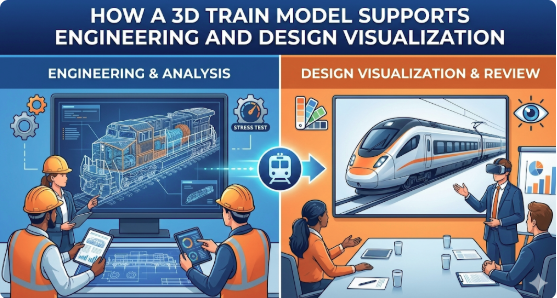
The scope and deployment of rail projects is rapidly expanding with the advent of high-speed systems, dense city centre integration, and elevated infrastructure, coupled with more demanding safety and technical compliance issues. The use of traditional 2D CAD drawings and blueprints is often not appropriate in giving an unambiguous understanding of these details to engineers, planners, and other decision makers.
That‘s where a 3D train model makes an important contribution by allowing such processes as technical data to be visualised in an immersive, realistic context that can then be more quickly tested, refined, and communicated.
What Is Engineering Visualisation With Reference To Rail?
Engineering visualisation involves displaying technical data visually so systems, workflows, and end products can be simulated before physical construction. Within rail, this might include emerging concepts such as train bodies, bogie frames, traction packages, station platforms, track assemblies, signage, and system control technology, as well as the surrounding landscape.
Rail engineering teams need to overcome space constraints, complex multi-system vehicle integration, aerodynamics, and safety issues. Viewing plans in a 3D context enables better decision-making, avoiding expensive errors, and promotes collaboration outside restricted engineering disciplines. This replaces extensive reading of annotations and assembly drawings with common 3D models that can be viewed at natural scales and proportions.
How Does 3D Modeling Help Train Engineers?
3D modeling helps make the design more tangible and precise, allowing team members to imitate real conditions (such as ventilation parameters, electromagnetic interference, or mechanical clearances). Changes to the design can be projected in a simulation in place of having to construct a physical prototype.
Using a 3D train model, engineers can:
- Check the structural integrity and physical fitting of components,
- Simulate airflow, resonance, and vibration characteristics,
- Tweak the user environment,
- Support safety regulations compliance,
- Streamline design monitoring, obviating reengineering efforts in each stage of design.
Increasing Accuracy And Multi-Team Collaboration In Design
The fact that 3D visualisation can be used by a diverse set of teams working from the same source is invaluable. Rail projects tend to evolve along civil, mechanical, structural, and electrical streams, all working on the same solution in tandem. By using the same 3D environment, all parties can work with the same precise image.
Identifying and solving clashes or clearance problems is easier, as you can study the model from whatever view you prefer. Detaching and splitting the 3D train can identify collision problems hidden on 2D elevations or schematics. This yields a more detailed interdisciplinary design, better reflecting the project‘s functionality.
Any updates or simulations are instantly relayed to everyone involved, maximising consistency and minimising errors.
Simulation And Performance Analysis
Aside from the presentation strengths of 3D models, 3D visualization company also provides a basis for tests and animations. These allow evaluation of real-world conditions before the system is built.
Useful applications include:
- Aeroacoustic impact,
- Loading and inertia calculations,
- Lighting and controls, and
- Vibration performance.
Virtual solutions are also a practical way of determining emergency planning solutions.
Being able to virtually test a variety of parameters is extremely budget-friendly and easier to fix than any afterthought.
Enhanced Communication Of Concepts To Stakeholders
Rail projects usually require the consent of various sources. These might be financial investors, government authorities, or communities impacted by new infrastructure. Terms and concepts are difficult to explain visually, other than with hardcopy reports or images. Beautifully rendered photos, realistic visuals, wow, these audiences.
A true-to-life depiction of a train makes complicated technical issues easier for amateurs to understand and obtain more quickly, expediting approval and financial support. Several media artists are able to produce stunning, hyper-realistic, broadcast-level images.
This is very useful when the project requires exhibition presentations, media coverage, investor pitches, or regulatory submissions.
More Effective Design, More Rapidly Saving Costs
A quick analysis of a potential problem comes one step closer to eliminating expensive reengineering in later stages of design. The virtual prototype may be refined and iterated using fewer physical models, avoiding delays caused by retooling.
Design changes are implemented more conveniently, saving time and preventing cost overrun, ensuring deadlines are more likely to be achieved. These savings increase over the lifetime of a successful project.
Cost Savings Throughout Asset Life
The cost of a 3D train model does not diminish with time, as the digital asset can be used through its lifetime. Engineering teams can use models for shutdown planning and maintenance instruction.
Asset operators might use a 3D replica for future planning even decades after the system is introduced.
Conclusion
A single status report can hardly do justice to the breadth of a successful modern rail project. The ability of a 3D model to enable more complete visualisation, easy simulation, and cross-team communication has benefits for every stage of design, from definition to delivery. Likewise, the long-term deployment of digital assets continues through operational life and the lifespan of these valuable infrastructure investments.
